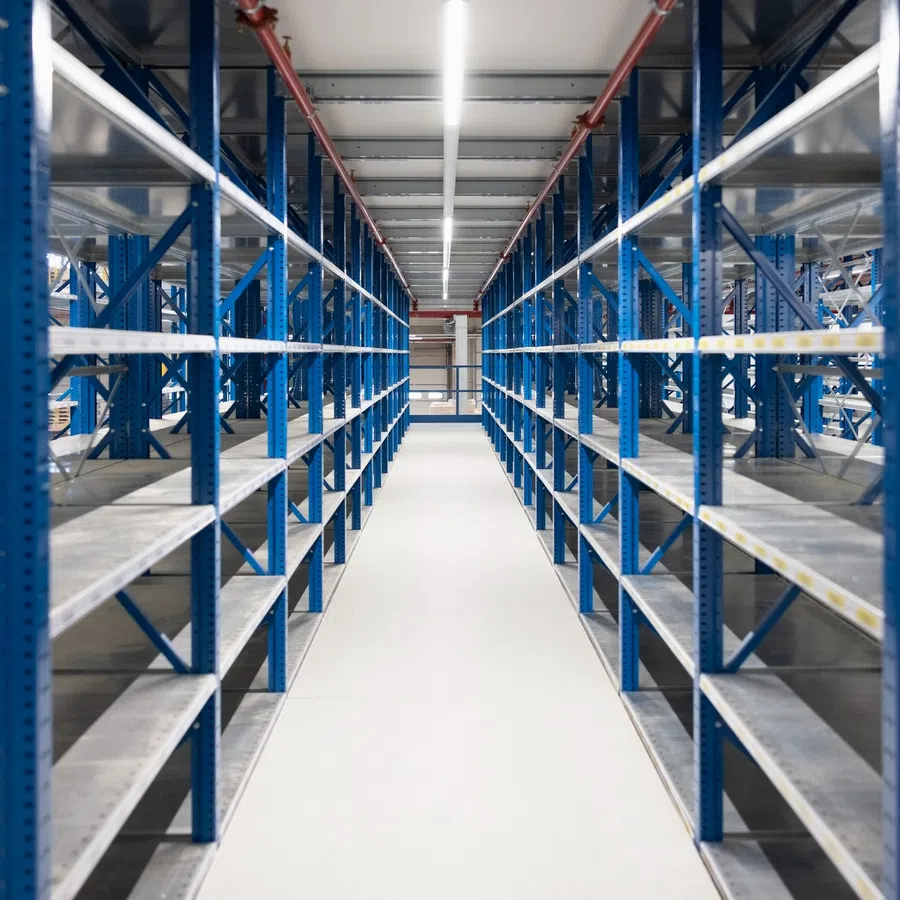
Long aisle of empty blue steel shelving units with white shelves under bright lights

Industrial Shelving in Atlanta, GA

Shelving Sized to Your Parts.

Shelving for parts rooms, MRO stores and pick areas, sized to your items and installed by our Atlanta crews across the Southeast.

Organize Your Stockroom

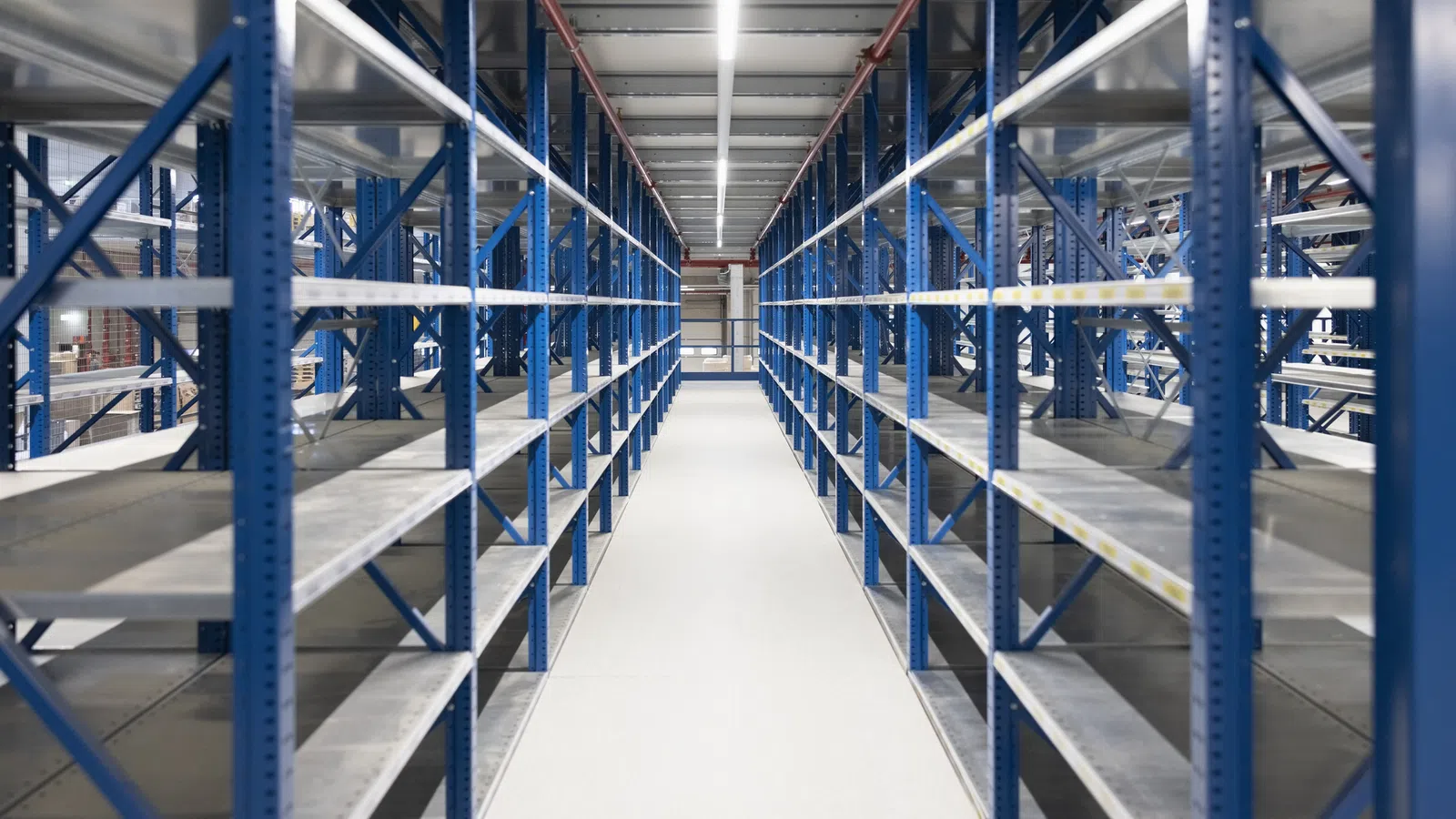
Narrow aisle between tall empty blue steel shelving units, seen from floor level

What Industrial Shelving Does That Racking Will Not

Quick answer

Hand-load storage on shelves rather than pallet positions. The distinction that matters is access: shelving is picked by people, racking is served by a forklift, and that difference sets the depth, the pitch and the aisle width.

That distinction drives everything else

Shelf depth is set by arm reach rather than pallet depth. Levels are closer together. Capacity per shelf is measured in hundreds of pounds rather than thousands. And the aisle in front of it is sized for a person and a cart, not a lift truck.

Most facilities need both. The fast movers go on racking; the long tail of small parts goes on shelving.

Six Types, and Which Fits Your Stock

The Range

Each solves a different combination of item weight, item size and pick frequency.

  • Type 01

    Boltless Shelving

    Beams lock into slotted uprights with rivets, no nuts, bolts, or clips. Assembles fast, reconfigures faster, and adjusts on roughly 1½ inch increments. The default for stock rooms and service parts. Decking options include particle board, steel, and wire.

  • Type 02

    Steel Shelving (Closed and Open)

    Welded or clip-assembled steel with shelves adjustable on close centers. Closed shelving adds side and back panels for dust control and to keep small items from pushing through to the next aisle. Heavier duty than boltless per shelf.

  • Type 03

    Wide Span Shelving

    The gap between shelving and racking. Longer spans and heavier capacity than standard boltless, still hand-loaded. For bulky, awkward inventory that does not palletize but does not fit a 36-inch shelf either.

  • Type 04

    Bin and Small Parts Shelving

    Shelving fitted with plastic bins, dividers, or drawer units for high-SKU, low-quantity inventory. Where the storage problem is finding the part, not holding it.

  • Type 05

    Mezzanine-Supported Shelving

    Shelving on a mezzanine deck, or shelving-supported catwalks where the shelving itself carries the walking level. Doubles usable floor area in a parts room without touching the building.

  • Type 06

    Mobile and High-Density Shelving

    Carriages on floor track that let you eliminate all but one aisle. Highest density available for hand-picked stock.

Rooms We Fit Out Most Often

Applications

Parts rooms, maintenance stores, order picking, and anywhere the SKU count outruns the floor.

Service Parts and MRO

The most common application. High SKU count, low quantity per SKU, picked by hand all day.

Distribution Pick Faces

Case and each picking in front of bulk pallet storage, often fed by carton flow on the fast movers.

Work Out What Suits Your Stock

Shelving selector

Enter what you are storing, how heavy it is and how often you pick it. The tool returns the type that fits and where the layout will cost you.

Shelving selector
Indicative: confirmed at design
Indicated shelving

40 lbs per item ·14 ft ceiling ·200 picks/day

Rivet or closed-back shelving

Shelf depth
12 to 24 in
Capacity per shelf
300 to 800 lbs
Access
Hand pick

Small parts and cartons at 40 lbs suit standard industrial shelving. The decision that actually matters here is shelf pitch, because too many shelves waste steel and too few waste cube.

Pallet racking, not shelving

Shelf depth
42 to 48 in
Capacity per shelf
Per beam level, engineered
Access
Forklift

Once loads are palletised or individual items pass roughly 2,500 lbs, you are out of shelving territory. Pallet racking is the right structure and it is priced and engineered differently.

Cantilever rack

Shelf depth
Arm length to suit
Capacity per shelf
Per arm, engineered
Access
Forklift or hand

Long or awkward stock does not fit between uprights. Cantilever arms give an unobstructed face so material loads from the side without fighting a front column.

Structural or heavy-duty steel shelving

Shelf depth
24 to 36 in
Capacity per shelf
2,400 lbs
Access
Hand, with lift assist

At 800 lbs per item the shelf itself becomes the engineering problem. Heavy-duty or structural shelving carries the load without deflecting, and the beam depth follows the item, not the aisle.

Wide-span shelving

Shelf depth
24 to 36 in
Capacity per shelf
800 to 2,000 lbs
Access
Hand or order picker

Wide-span sits between shelving and racking: longer beams for cases and totes, without the forklift clearances racking needs.

At 14 ft of ceiling, hand-picked shelving alone leaves cube unused. A shelving-supported catwalk or mezzanine recovers the upper levels.

At 200 picks a day the layout and the golden-zone placement will save more labor than the shelving type will.

Get This Quoted
A starting point, not a specification. Final layout follows a review of your SKU profile, aisle widths and pick rates.

Shelving or Pallet Racking for Your Loads

Comparison

The boundary is where the design work happens

Five decisions that determine whether shelving works

Decision The rule Why it matters
Height Reach, not ceiling height The top shelf should be reachable without a step. Above roughly 72 in becomes a ladder problem, and a ladder problem becomes a safety problem.
Depth By hand, not by pallet Standard depths run 12, 18, 24, and 36 in. Deeper shelving looks efficient and picks terribly, because anything at the back of a 36 in shelf gets forgotten.
Capacity Per shelf, not per unit A unit rated at 3,000 lbs across six shelves is 500 lbs per shelf. Loading one shelf to 1,500 lbs is how shelving fails.
Decking To the load Particle board for cartons and light parts, steel for heavier or oily inventory, wire where sprinkler water needs to pass through.
Aisle width For a cart Typically 36 to 48 in for a person with a cart or picking trolley. Wider wastes floor, narrower slows picking.

Storage Fit-Outs Across Georgia

Recent work

Parts rooms, maintenance stores and pick areas laid out and installed by our own crews. The gallery shows the finished runs, the shelf pitch and the aisles.

What Buyers Ask Us About Storage

FAQ

If your question isn't here, call the shop. We'd rather talk it through than have you guess.

Can you install without shutting the stores down?

Normally yes. Shelving goes in bay by bay, so we can work a section at a time and move stock across as we go rather than emptying the room.

How does the cost compare with racking?

Lower per bay, but not per pallet position. If your loads are palletized, racking will almost always be cheaper for the same cube, which is what the tool above is checking.

Do you handle the permit and inspection?

Our shelving installations include the permit and the inspection, plus the seismic anchoring, and any catwalk or platform work is engineered rather than assembled.

Can shelving carry a catwalk?

Yes, at lower load ratings than a structural mezzanine. Shelving-supported catwalks suit small parts picking and lock in the layout below, which is the trade-off.

Can you handle a project our size?

From a single maintenance store to a full pick area rebuild.

Send Us the Space and the SKU Profile

Start a shelving project

Room dimensions, ceiling height, and a rough idea of what is going on the shelves. We will lay it out and quote it.