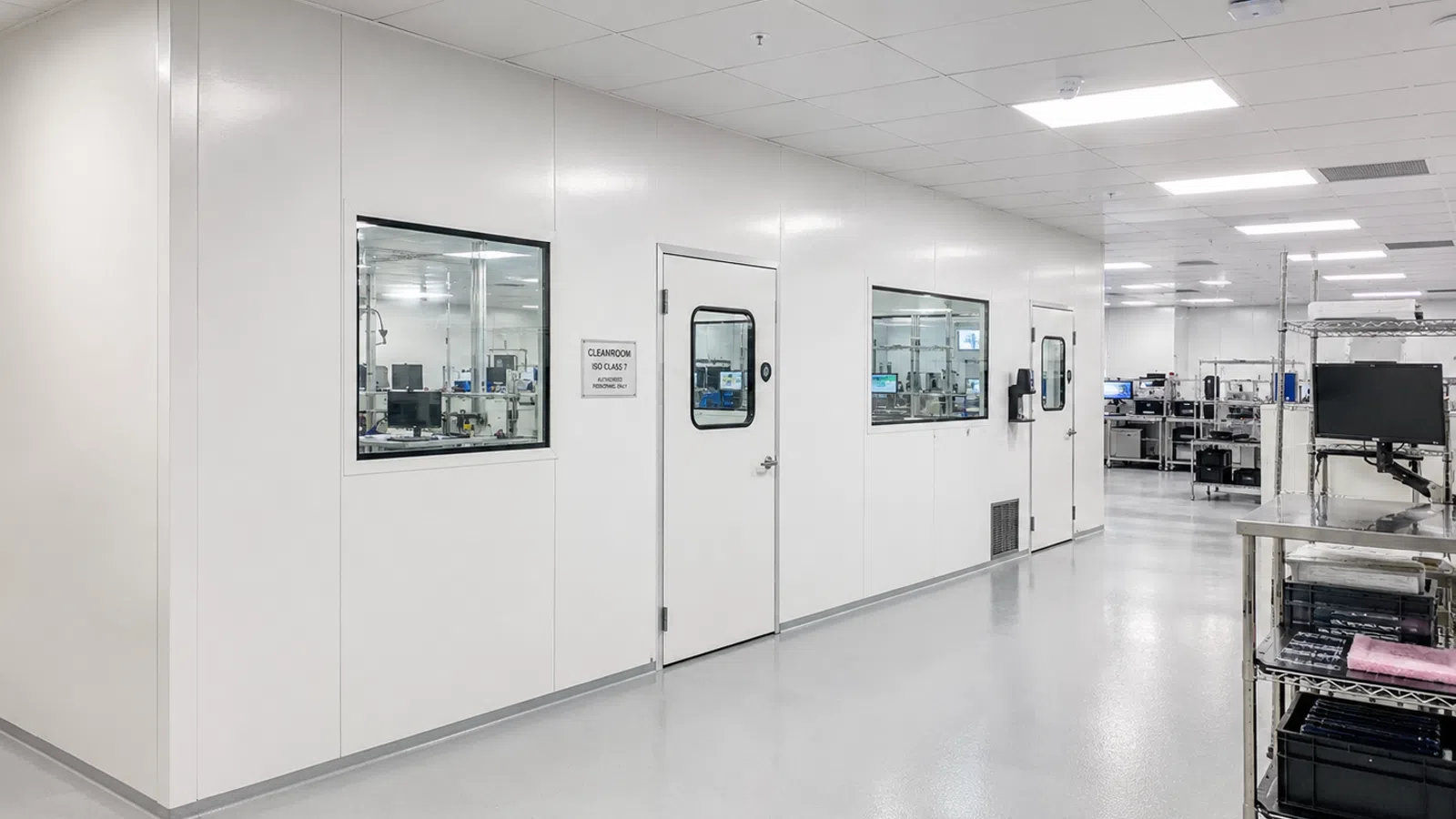
Hardwall Modular Cleanrooms in Atlanta, GA
Sealed Walls. Stable Pressure.
Sealed, rigid-panel cleanrooms that maintain ISO 5 to ISO 8 pressure differentials, built as complete projects across the Southeast.
Price a Hardwall Room
What a Hardwall Cleanroom Is
In 30 Seconds
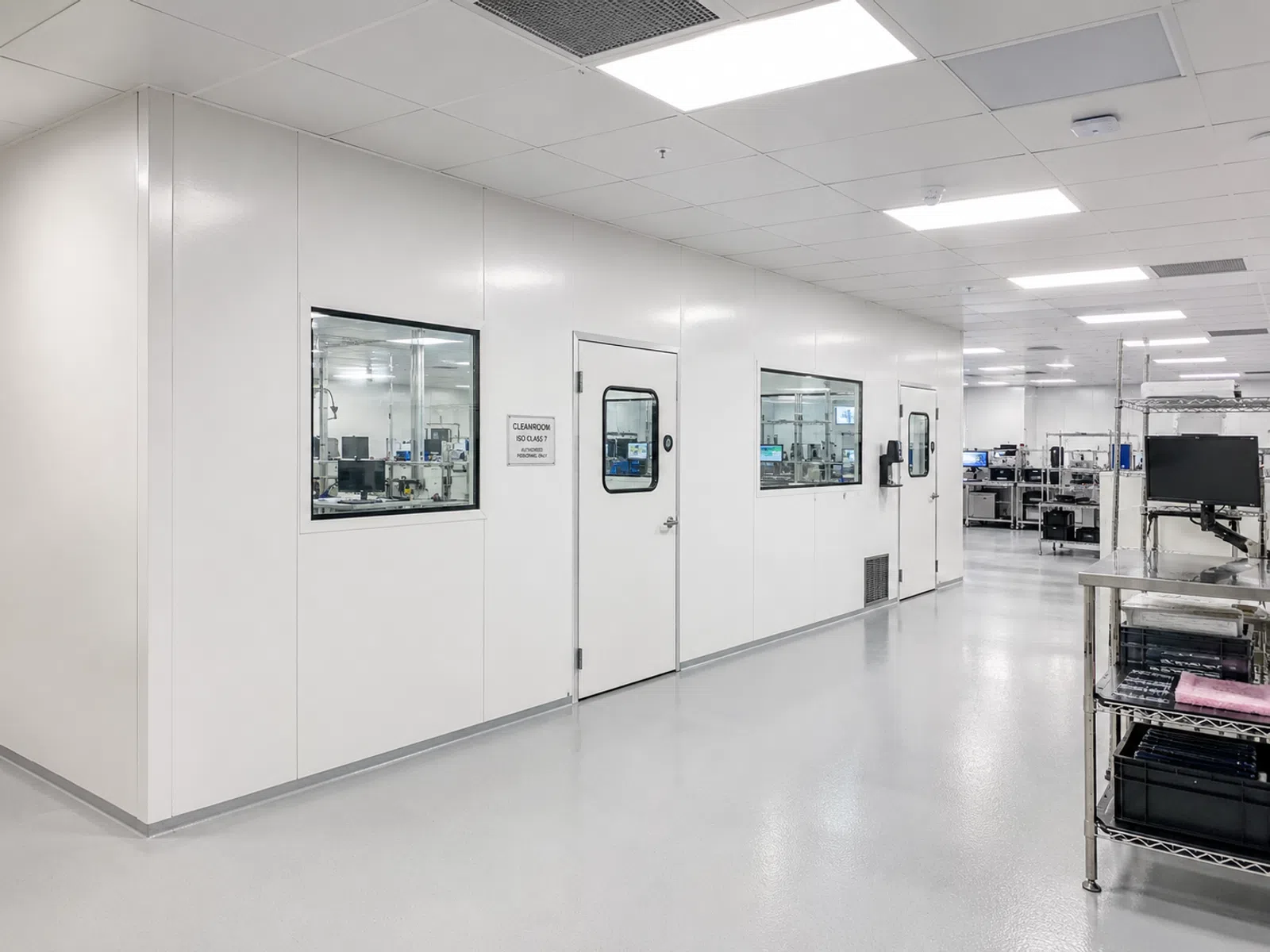
A hardwall cleanroom is a controlled environment built from rigid, sealed wall panels with a supported ceiling grid, creating a fully enclosed envelope inside an existing building. Panels arrive finished and cut to size; the room is assembled on your slab with no wet trades.
The defining characteristic is the seal. Every joint, penetration, and floor-to-wall junction is closed, which is what allows the room to hold a pressure differential relative to the space around it. Air leaves the room rather than entering it, so unfiltered plant air never migrates in through a gap.
- What it is. A rigid-wall cleanroom built from solid, sealed panels rather than hanging vinyl. A permanent room inside your building.
- What it achieves. ISO 5 through ISO 8, with real pressure differential and humidity control.
- Why hardwall over softwall. Curtains leak air. If you need to hold a pressure cascade or certify to a tight class, the envelope has to seal.
- Where it fits. Medical device assembly, sterile compounding, electronics, aerospace composites.
Where Hardwall Is the Right Choice
And Construction
Wall panels are rigid, sealed, and load-bearing, configurable to a 40 ft clear span, with finish options including steel, aluminum, FRP, vinyl-covered gypsum, and hardboard. The ceiling is a supported grid carrying fan filter units, lighting, and sprinkler drops, with filtration at HEPA to 99.97% at 0.3 micron, or ULPA for tighter classes. Pressure runs positive as standard, negative for containment. Doors are gasketed and interlocked where the entry sequence requires it, and the floor is seamless, coved to the wall.
Finish selection follows the cleaning regime rather than the class. FRP and coated metals stand up to the disinfectants used in medical device and pharmacy environments, while vinyl-covered gypsum does not.
Built and Installed in Atlanta, GA
Full-Scope Delivery
We design, supply, and install hardwall cleanrooms across Georgia and the Southeast as complete projects - not shipped kits.
HVAC sized to the class, not the floor area. Air change rate is the largest cost driver after square footage, and getting it wrong is what makes a room fail certification.
One contract from the slab up. Floor prep and coating, the envelope, filtration, electrical, and the air shower or gowning sequence, all under our Georgia contractor license. See modular clean rooms for the full scope.
Frequently Asked Questions
FAQs
How much does a hardwall cleanroom cost?
Floor area, ISO class, and HVAC scope drive it. A small ISO 8 enclosure and a large ISO 5 suite differ by an order of magnitude at the same square footage, because the air change requirement scales far faster than the room does.
Can a hardwall room reach ISO 5?
Yes. ISO 5 requires high filter coverage of the ceiling - commonly 35 to 100 percent - and several hundred air changes per hour. The sealed envelope is what makes holding that practical.
Can it be relocated later?
Yes. Panels are demountable and the room can be expanded, reconfigured, or moved. The HVAC needs re- evaluating for the new location since the heat load usually changes.
How is it certified?
Tell Us the Class and the Square Footage
Start a project
ISO class, room size, and what happens inside it.